
You are scrolling through your feed late at night when you see it, a close-up video of someone’s hands, nails so flawless they look airbrushed. The polish sits seamlessly against the skin, no visible gap, no rough edges. The caption reads “Russian manicure” and promises results that last for weeks. Your heart does a little flip. You’ve been searching for a way to avoid constant nail salon visits, the chipped polish that appears three days after you’ve paid for a fresh maani.
But then doubt creeps in. You remember reading somewhere that removing cuticles is dangerous. A friend mentioned infections. Your dermatologist once said something about leaving cuticles alone. Now you’re caught between the promise of photo-ready nails and the fear of damaging your nail health. The internet doesn’t help, beauty influencers swear by the technique while medical articles warn of risks. Who’s right?
The truth is, the question “Is it bad to remove cuticles in a Russian manicure?” doesn’t have a simple yes or no answer. What matters is what is being removed, how it’s being removed, and who is doing the removing. This article will walk you through the biological role of your cuticles, explain what makes Russian manicure technique fundamentally different from traditional methods, and help you understand the real risks versus the myths. By the end, you’ll know exactly what to look for in a safe Russian manicure and how to protect your nail health while achieving that coveted, long-lasting finish.
What makes Russian manicure different from traditional cuticle care?
The Russian manicure represents a complete departure from the nail care techniques most of us grew up with. Instead of soaking your hands in warm, soapy water and using metal nippers to trim cuticles, this method is entirely dry and relies on an electric file (e-file) equipped with specialized diamond bits. There’s no water bowl, no softening agents, and no manual cutting tools involved.
Here’s where the precision comes in. Traditional manicures soften the cuticle area with water, making it difficult to see exactly where dead tissue ends and living skin begins. The Russian technique works on completely dry skin, allowing the technician to clearly distinguish between the pterygium (the thin layer of dead cuticle tissue that clings to your nail plate) and the eponychium (the living skin fold that protects your nail matrix). The e-file performs micro-exfoliation, gently buffing away only that dead pterygium without touching the protective living tissue.
This dry approach matters more than you might think. When you soak your nails in water during a traditional manicure, your nail plates absorb moisture and expand. Once gel polish is applied to these water-swollen nails, they begin to contract as they dry over the next few hours. This expansion and contraction cycle is why gel polish often lifts at the edges within a week. Russian manicure eliminates this problem entirely by working on stable, dry nail plates.
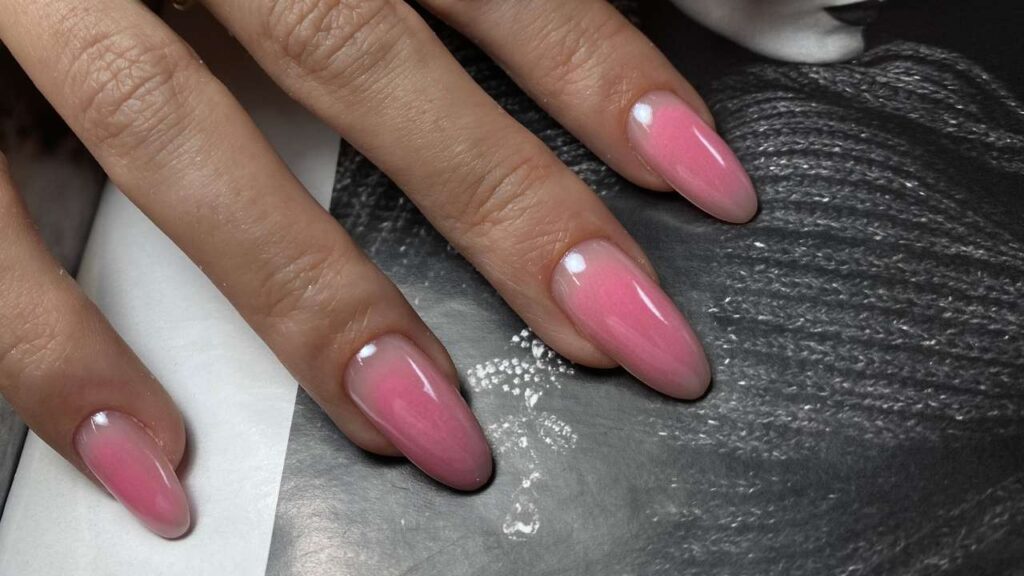
The visual result is striking. Because the dead tissue is removed so precisely, polish can be applied extremely close to the cuticle fold, sometimes appearing to sit “under” the skin line. This creates a seamless, high-definition finish with no visible gap between polish and skin. More importantly, this meticulous preparation allows manicures to last three to five weeks without showing obvious regrowth, making it ideal for busy professionals who can’t afford frequent salon visits.
Your cuticle’s protective role
Before we can answer whether removing cuticles is harmful, we need to understand what cuticles actually do. Your cuticle isn’t just one thing, it’s actually two distinct components with very different functions.
The eponychium is the living skin fold at the base of your nail. This is what most people think of when they hear the word “cuticle.” It acts as a waterproof seal, creating a protective barrier between your nail plate and the nail matrix beneath it. The nail matrix is essentially your nail’s growth engine, the area where new nail cells are constantly being produced. When the eponychium is intact, it prevents bacteria, fungi, viruses, and other pathogens from entering this vulnerable growth area.
The pterygium, on the other hand, is the thin layer of dead, translucent tissue that adheres to your nail plate as it grows out. This is the material that creates that rough, whitish film you sometimes see on your nails. Unlike the eponychium, the pterygium serves no protective function, it’s simply dead tissue that needs to be removed for a clean nail surface.
“The cuticle is the body’s natural defense against infection. When intact, it creates a seal that prevents bacteria and fungi from entering the nail matrix.” , American Academy of Dermatology
The American Academy of Dermatology recommends leaving cuticles intact specifically because they’re referring to the living eponychium. When this protective seal is cut or removed, you’re essentially opening a doorway for infection. The nail matrix beneath becomes exposed to everything your hands touch throughout the day, door handles, keyboards, gym equipment, and countless other surfaces harboring bacteria.
This is why the safety debate around Russian manicure centers on one critical question: Does the technique distinguish between living and dead tissue? When performed correctly, Russian manicure removes only the dead pterygium while carefully preserving the living eponychium. When performed incorrectly, by cutting into the living tissue, the risks become very real.
The real risks when cuticle removal goes wrong during Russian manicure
When cuticle removal is done improperly, the consequences can range from uncomfortable to medically serious. Understanding these risks helps you recognize warning signs and know what questions to ask before booking an appointment.
Common complications include:
Acute paronychia: This bacterial or fungal infection develops when the protective seal is broken, allowing pathogens to enter the space around your nail. You’ll notice intense redness, swelling, and throbbing pain around the affected nail. In many cases, pus forms beneath the skin, creating pressure that makes even light touch painful. These infections typically require antibiotics and can take weeks to fully resolve.
Onychomycosis (fungal nail infection): Once fungi establish themselves in the nail bed, they’re notoriously difficult to eliminate. Your nails may become thickened, discolored (often yellow or brown), and brittle. The infection can spread to other nails and requires months of antifungal treatment, sometimes including oral medications with potential side effects.
Nail plate damage: This occurs when the e-file is used with excessive pressure or at incorrect angles. The high-speed rotation can thin your nail plate, creating painful grooves or “rings of fire” that feel hot and sensitive. Some people experience chronic nail sensitivity after repeated trauma, where even normal activities like typing become uncomfortable. Over time, this can compromise the structural integrity of your nails, making them prone to breaking and peeling.
Chronic inflammation: This develops when the area around your nail is repeatedly traumatized. Your body responds by producing scar tissue or developing abnormal growth patterns. You might notice horizontal ridges (Beau’s lines), permanent thickening, or nails that grow in irregular shapes. These changes can persist even after you stop getting manicures.
Onychomadesis: In severe cases, infection or trauma can trigger this condition where your nail separates from the nail bed and eventually falls off. The nail matrix temporarily stops producing new cells, and you have to wait several months for a completely new nail to grow back.
The critical point is this: these complications aren’t inevitable consequences of Russian manicure. They result from incorrect technique, inadequate training, or poor hygiene standards. When the living eponychium is cut instead of preserved, when the e-file is wielded by untrained hands, or when sterilization protocols are ignored, the risks multiply dramatically.
How Xpert Russian Manicure Salon provides safe cuticle care
At Xpert Russian Manicure Salon, we’ve built our entire practice around eliminating the risks associated with cuticle care while delivering the flawless results you’re looking for. Our approach centers on one fundamental principle: preserve the living tissue, remove only what’s dead.
Our certified technicians use micro-exfoliation to gently buff away the pterygium, that thin layer of dead cuticle tissue clinging to your nail plate. There’s no cutting involved. The e-file, when used correctly, acts like a precision eraser, removing only the material that no longer serves a purpose. The living eponychium, your nail’s natural protective seal, remains completely intact. This means there’s no open wound, no pathway for bacteria or fungi to enter, and no inflammation cycle that triggers aggressive cuticle regrowth.
Our safety protocols include:
Advanced training in nail anatomy: Every technician receives comprehensive education before working with clients. They learn to identify the exact boundary between living and dead tissue, master e-file speed control, understand proper pressure management, and select the appropriate diamond drill bits for each client’s nail condition.
Medical-grade sterilization: We use professional e-file systems with specialized diamond drill bits designed for surgical-level accuracy. After each client, all e-file bits are sterilized using autoclaves, the same hospital-grade equipment used to sterilize surgical instruments.
Dry technique precision: When your nails aren’t softened with water, we can clearly see the boundary between living and dead tissue. There’s no guesswork involved. Our technicians can work with precision that’s simply impossible when cuticles are water-swollen and obscured.
Client communication: You should never experience pain, heat, or sharp sensations during a Russian manicure. If you do, we want you to speak up immediately. Bleeding is never normal, and any discomfort is a sign that something needs to be adjusted.
Before your first appointment, we ask about health conditions like diabetes, circulation problems, immune issues, or nail infection history. These factors can affect how your body responds to nail services, and we adjust our approach accordingly to maintain your safety.
FAQs about remove cuticles in Russian manicure
Is it safe to remove cuticles with an e-file?
Safety depends entirely on what’s being removed and who’s performing the service. Removing the dead pterygium (the translucent tissue on your nail plate) with proper e-file technique is both safe and beneficial for nail health. However, cutting into the living eponychium (the protective skin fold) is never safe, regardless of which tool is used. Certified technicians with advanced training can safely distinguish between these two types of tissue. When you choose a salon where technicians understand nail anatomy and use micro-exfoliation rather than cutting, e-file cuticle removal is a safe, precise method that actually protects your nail health better than traditional nippers.
Will removing my cuticles make them grow back thicker?
This common concern is based on a real phenomenon, but it only applies to improper technique. When the living eponychium is cut, your body interprets this as an injury and triggers an inflammatory response. This inflammation causes rapid, thicker regrowth as your body tries to restore the protective barrier. However, proper Russian manicure technique removes only the dead pterygium, which doesn’t grow back because it’s not living tissue. By preserving the living eponychium and avoiding the inflammation cycle, you actually experience slower, healthier cuticle growth over time. Many clients notice their cuticles become less aggressive and easier to maintain with consistent proper care.
What should I do to maintain my Russian manicure at home?
Daily cuticle oil application is your most important maintenance step. Professional-grade jojoba oil is particularly effective because its molecular structure allows it to penetrate the gel polish, maintaining flexibility and preventing the cracking that leads to chipping. Apply it to your cuticles and nail edges every evening before bed. Wear waterproof gloves whenever you’re doing dishes, cleaning, or any activity involving prolonged water exposure. Water doesn’t just soften your skin, it creates stress on the gel bond that can cause lifting. Avoid harsh chemicals and excessive hand washing without immediately moisturizing afterward. These simple habits extend your manicure longevity from three weeks to five weeks while supporting overall nail health.